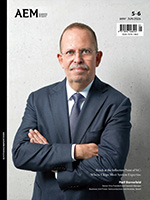


Automotive’s New Layers At first glance, the booths at Auto China 2026 seemed to be showcasing completely different products. Some companies were building AI models. And above it all, global Tier 1 suppliers were rebuilding the structures of validation, responsibility, and industrialization. This series is not a collection of company profiles..jpg)
The shift didn't arrive quietly.
Auto China 2026 was not a show about surface changes. It was confirmation that the structure itself had moved. While the big names were rebuilding ecosystems from the front, quieter booths — ones that hid capability behind anonymity — were rewriting the layer below. This article records two transitions at once: the one happening inside China, and the one reshaping the space between China and the West. The car has started becoming something else.
by Sang Min Han _ han@autoelectronics.co.kr
한글로보기
In reality, they were revealing parts of one massive new stack.
Others were redesigning the flow of data inside the vehicle.
Some were turning maps into operational systems, while others were transforming glass itself into an interface.
It is a record of the new layered architecture of the automotive industry now emerging from China.
As NOA and L2+++ Expand, Autonomous Driving is Now a Race against Time
Horizon Robotics: Why are Bosch and ZF on that wall?
Beyond Speed and Cost: How Autolink Is Approaching the Global Market
A Map Company No Longer Sells Maps
Rockchip Executes: "Turn Off the Airflow, Then Turn It Back On"
Kotei′s 80:20: An Experiment in AI-Based Automotive Software Engineering
NanoAR, The Day Glass Becomes a Screen
Finale: Bosch Switches On Level 3 in China
In one corner of the hall, a golden horse ran across a transparent film. Behind it, the exhibition floor was fully visible.
Two images. One surface. Both real. NanoAR's full-domain window display.
Nearby, a black terminal at the Rockchip booth scrolled without pause. 'Kill the airflow. Restart in ten seconds.'
The AI board responded in under 100 ms. No internet. No cloud. Everything processed inside the car.
At the CATL booth: '6-minute charge · 1,500 km range · No Liquid Electrolyte' — and beneath those words, the Shenxing Battery III pack laid open. At DeepRoute.ai, founder Maxwell Zhou stepped up: 'Raising autonomous driving safety ten times, a hundred times — it's impossible without large foundation models.' On the wall of the Horizon Robotics booth, real ECU modules from Bosch and ZF hung side by side. Center floor, Volkswagen unveiled the ID. UNYX 09 — co-developed with Xpeng in 24 months. Xiaomi poured the SU7, YU7, XRING O1 SoC, crash-test footage, battery protection architecture, and its home-appliance ecosystem into one booth. Huawei claimed the largest footprint in the show. Not just in floor space. In position.
None of these were separate stories. Inside 380,000 m², they were the same question, asked simultaneously.
What is a car?
Augustin Friedel of Germany's MHP: 'Any company not developing directly inside the Chinese ecosystem will end up watching the change through the rearview mirror. In China for China is no longer enough. In China for the World is the new strategic language.'
Andrew Hart of SBD Automotive: 'Western OEMs can't afford to leave China. Chinese OEMs can't afford to stay only in China. More and more OEMs are becoming ecosystem players.'
Late April. Three days. No stopping. 1,451 vehicles. 181 world premieres — a global record. But the numbers are beside the point. Auto China 2026 was not a new-car show. It was where the weight of an entire industry visibly shifted.
.jpg) Bosch stepped into China's pace — and held on to verification and accountability at the same time.
Bosch stepped into China's pace — and held on to verification and accountability at the same time.
Bridging China and Europe, not choosing between them.
ACT I · THE GROUND SHIFTS
Western OEMs With Nowhere to Go
When BYD's booth swallowed Europe's largest motor show at IAA 2023, the Western industry watched and waited. Chinese cars were selling. Quality had arrived. Beijing 2026 confirmed the waiting was over.
Volkswagen showed what OEM response looks like at its most direct. 'Developed in China, for China.' The ID. UNYX 09, built on the CEA (China Electronic Architecture) platform co-developed with Xpeng, completed in 24 months — less than half the traditional OEM cycle. The ID. ERA 9X carries Momenta's reinforcement-learning world model R7. From 2026, every CEA-based vehicle ships with an onboard AI agent. Volkswagen didn't adapt to China from the outside. It moved in. It chose to develop like China — not as a concession, but as a strategy.
Tier 1s responded differently. Bosch CTO Matthias Pillin described the shift at The Autonomous, shortly after IAA last year. A two-stage E2E AI system developed in China, brought to Germany, demonstrated at IAA after only a few hundred hours of additional training. But not a pure black box — a hybrid, with a VLM layer on top of E2E, precisely because failures on real roads have to be traceable. Bosch is not moving into China. It is building in China and exporting the result. The scene at the Horizon Robotics booth — Bosch and ZF modules on the wall — said it plainly: who makes the chip, and who rides on top. The question of who became the platform.
But the shift runs both ways. While the West learns China's speed, China is learning something else. Accountability. China's MIIT has begun mandating minimum-risk conditions in its draft Level 3 requirements. DSSAD logging is moving toward obligation. One autonomous driving executive on the floor: 'The core of intelligent driving is not speed. It's the boundary.' China is learning responsibility in order to go global.
.jpg) Huawei occupied the largest booth at the show. Not just in floor space — as a statement of where it now stands inside the automotive industry.
Huawei occupied the largest booth at the show. Not just in floor space — as a statement of where it now stands inside the automotive industry.
ACT II · THE ECOSYSTEM REWRITES THE RULES
The Visible Giants Companies You Know Took the Floor
The truly unsettling thing at Auto China 2026 was not BYD's volume or CATL's specs. It was that companies which had never studied automotive walked onto the floor as if they owned it.
One circuit of the Xiaomi booth makes it clear. Next to the SU7 and YU7: the XRING O1 in-house SoC, a MiMo-based AI agent, the HyperOS ecosystem. The car wasn't positioned as a product. It was positioned as the final node in the Xiaomi user experience. The message wasn't 'we make good cars too.' It was: 'the car is where our ecosystem ends.' And alongside that: crash tests, battery protection structures, chassis architecture — all front and center. The company used to make apps. Now it was talking about body rigidity. That wasn't a pitch. That was a license plate.
Huawei went further. Through Yinwang (引望), it has vertically integrated from autonomous driving algorithms down to cockpit hardware. ADS 5.0 claims a 50% reduction in collision risk, already deployed for Level 3 highway autonomy in AITO and Arcfox vehicles. The Huawei booth was where that intent became architecture. DriveONE electric powertrain. XMC vehicle motion control. ADS/CAS intelligent driving. HarmonySpace cockpit. AI agents and app ecosystem. Not individual components — a layered stack of electrical, electronic, software, AI, and experience systems presented as one vehicle operating system. No spec sheets. Real scenarios: urban commuting, long-distance travel, off-road driving. Technology framed not as performance, but as experience, safety, ride quality. What Huawei wants is not better infotainment. It wants to be the company that designs how a vehicle is operated.
If Huawei is designing the operating system, BYD is something different. It builds batteries, motors, semiconductors, software, charging infrastructure, and ADAS — and sells them itself. It isn't targeting platform status. It is trying to be the platform.
The CATL booth wasn't a battery supplier's display. Shenxing III, Qilin III, condensed batteries, sodium-ion Naxtra Battery, swappable battery systems — all in one space, binding charging speed, cold-weather performance, safety, longevity, cost, and resource recycling into a single industrial infrastructure argument. '6-minute charge. 1,500 km range. -30°C charging. No Liquid Electrolyte.' Not a spec competition. A message: we will remove, one by one, every real anxiety EV users carry. Where BYD is an execution system, CATL was showing that energy storage, charging, operations, and recycling have become the central operating infrastructure of the automotive industry itself.
.jpg) In China's SDV ecosystem, companies are no longer selling single functions. They are building the invisible infrastructure that intelligent vehicles need to operate — and to scale globally.
In China's SDV ecosystem, companies are no longer selling single functions. They are building the invisible infrastructure that intelligent vehicles need to operate — and to scale globally.
The Other Side of the Floor
The Deeper Shift, Beyond the Big Names
Past the marquee booths are other spaces. Smaller. But these are the companies that prove the change is not surface-level. The real depth of the show was here.
Rockchip's on-device AI controls vehicle functions in under 100 ms with no cloud. The practical constraints of latency, bandwidth, and data sovereignty have begun to crack cloud-dependent architectures. Kotei's SDW uses a multi-agent system to handle AUTOSAR configuration, code generation, and testing. 20% human. 80% AI. Engineers no longer write the code. Agents do. This is more than a signal that the grammar of software development is shifting.
Seeway.ai has gone from mapping company NavInfo to an SDV infrastructure firm — data compliance, ADAS, cockpit integration, chip support, global deployment, all bundled. The company that most deeply understands Chinese regulation is using that understanding to go global. The paradox is the strategy. Autolink, with a production reference base of more than two million vehicles, has begun pitching its fiber-optic centralized computing architecture directly to global OEMs. NanoAR is turning glass into interface. Partition, sunroof, side window, windshield — all become display layers.
Describe each separately and you get technology stories. Lay them side by side and you see structural change. While Xiaomi, Huawei, BYD, and CATL are rebuilding the ecosystem from the front, these companies are making the new order in the layer where the ecosystem actually runs. Proof that automotive hasn't just changed at the surface. Inside it, a car is no longer a product. It is an operated system. And inside that system, the existing OEM and Tier 1 structure is being asked a fundamental question.
ACT III · THE LOOP THAT OUTRUNS THE PROJECT
The Competitive Advantage Is Not Speed — It's the Loop
'China speed.' Two reactions, almost always. Either: 'Of course — China is fast.' Or: 'The quality must be questionable.' Both miss the point.
The right question is: how did they design an execution system capable of this pace?
Traditional OEM development is linear. Concept → design → prototype → validation → SOP. Gate by gate. Failures found late mean exploding costs, so everything is sealed at the front. China ships first. Watches. Fixes. Ships again. OTA is not a delivery mechanism. It is the development process. The DNA of the smartphone, app, and platform industries has entered the car.
The clearest account of how this loop actually works came from DeepRoute.ai's Chong Ruan, former chief scientist at DeepSeek: 'The real competitive advantage is not the model itself — it's how quickly you can iterate and improve.' The data collection → training → testing → revision cycle that once took over 100 hours has been compressed to around 10, through foundation-model-based pre-analysis and cloud simulation. The loop is ten times faster.
BYD is the clearest proof. Batteries, motors, power electronics, semiconductors, tooling, interior, exterior — all internalized. Not a car company. An industrial operating organism. A fleet of more than 2.85 million vehicles generating over 180 million km of driving data per day. Not a sales boast. The scale of AI training. The competitive advantage itself. Data drives the loop. The loop produces the next generation of ADAS and software. A company that binds energy, manufacturing, software, and data into a single execution loop. The most direct proof that China's automotive competitiveness comes not from price, but from vertical integration and data scale.
So why can't everyone build this loop? The answer isn't capability. It's reason. There was never a reason to build it.
In the traditional structure, speed was risk. Shipping before validation meant recalls. Recalls meant brand. Brand meant survival. That logic was not wrong. The problem is that the market it was valid for has changed. OTA-patchable software and recall-requiring hardware now live in the same vehicle. The moment that happened, verification-first linear development started losing ground to speed-first loops — structurally, not just competitively.
The Autolink booth put the remaining barrier plainly: 'The existing development processes, organizational structures, and supplier management systems of many OEMs were designed around distributed E/E architectures. Transitioning to centralized computing means fundamentally rethinking E/E architecture, software development methodology, and testing and validation frameworks — from the ground up.'
The barrier is not technology. Foundational technologies are maturing fast. The greater barrier is organizational inertia. Attachment to the way things have always worked.
This is what China speed actually is. Not the overtime headlines. The result of an entire company and supply chain having designed an execution loop. Every time the loop completes one cycle, organizations outside it fall a little further behind. The gap does not widen linearly.
.jpg) AI was taking over more and more of the judgment calls. The question was no longer how well the car runs.
AI was taking over more and more of the judgment calls. The question was no longer how well the car runs.
It was who bears responsibility for those decisions.
ACT IV · THE MINORITY REPORT
Authority Moves. Accountability Stays.
One frame still holds for understanding this industry's transformation. Minority Report.
Not because China predicted the future. Because China questioned premises the rest of the world had stopped questioning. Automotive development takes a long time. Quality is secured through extended validation. Software is a supporting function. China asked: is that actually true? Then pushed the answer into execution, not words.
In the film, the Precrime system claims to predict. In practice it functions as power — the power to name the criminal. The moment you believe the system sees the future, authority passes to the system. Accountability does not follow.
The same structure is forming in automotive. AI designs the route. Issues the judgment. The vehicle moves. Huawei ADS 5.0 makes Level 3 decisions. A Kotei agent writes the software. Rockchip executes the command inside the car.
DeepRoute.ai's VLA makes this structure most concrete. When a vehicle in the adjacent lane decelerates sharply without signaling, the system does not simply brake. It reasons: unsignaled deceleration → temporary bus stop ahead → pedestrian emergence likely → slow to avoid collision. A chain of thought, not a reflex. And Chong Ruan's words compress the whole problem: 'Do not use tools as your brain.'
Delegate judgment to AI — but designing the direction of that judgment must stay with humans. In practice, that boundary is dissolving. Authority passes to the system. Accountability does not follow. When an accident occurs? Responsibility returns to the OEM, the operator, the supply chain.
Data follows the same logic. 'You can take the model. But you can't touch the data.' AI judges. The model is made by a supplier. The data is held by the OEM. When something goes wrong — who is responsible? Whose data is the user's data? Who captures the in-vehicle service revenue? Are we a hardware supplier, or are we a company accountable for part of an operated platform?
Bosch and ZF on the Horizon Robotics wall. Standing there, looking at it, the sense that this question has already become real was unavoidable. Bosch and ZF riding on a Horizon chip is a signal about who has become the platform in this industry, and who has become the layer above it. The same question returns to every Tier 1 in the room.
Nation-states feel the tension too. China's MIIT draft mandatory safety standards for Level 3 and Level 4, published in February 2026, make two simultaneous demands: when a driver fails to respond, the system must autonomously change lanes and bring the vehicle safely to a stop; and a DSSAD equivalent to an aircraft black box must be mandatory, leaving a data record of every judgment made. Record who decided. Accountability will be demanded by the state. This standard takes effect July 2027. Non-compliance means a total ban on production, sale, and import in China.
The more authority moves, the larger the question of accountability grows. That mismatch will be the most heated battleground in this industry for years to come.
.jpg)
The golden horse suspended in midair was not a display demo. It was the moment the entire car window became an interface.
CLOSING · THE QUESTION LEFT OPEN
Who Writes What Comes Next?
Auto China 2026 is over. BYD showed an execution system. CATL showed an energy platform. Xiaomi showed a consumer electronics ecosystem. Huawei showed a bid for platform supremacy. Volkswagen and Bosch showed the present reality of a global OEM and Tier 1 relearning themselves inside China's pace. What they all share: they see a car not as a machine, but as an operated system. China has redesigned the execution architecture. The West is keeping up with China's speed while holding accountability as its line of defense.
But what kept people at booths the longest was neither platform nor data. Authority shifting, loops racing, ecosystems consuming ecosystems — all of it is aiming at the same place. What someone feels sitting inside the car. The last question is always experience.
The rear-seat remote in the AUDI E7X is hidden behind the center console island. Press it and the compartment opens — slowly, precisely. At the SenseAuto booth, an AI agent pulled dashcam footage with a single voice command. Inside the SAIC-Huawei Shangjie Z7, distributed displays connected so content flowed with intelligence, lighting and audio resolving into a single sensation. Guang Yang of Volkswagen Group's Diconium: 'Great automotive UX is not only screen size or feature lists. It lives in microinteractions. The direction is not more digital touchpoints — it is smarter orchestration.'
Experience is not something yet to be written. The question is who has started writing it more genuinely.
The articles in this issue are a field record of that transition. Bosch and ZF riding on top of a chip. AI executing inside the vehicle without cloud. The choice to move foundation models into production reality. The company that most deeply understands Chinese regulation using that understanding to go global. Knocking on global OEM doors from a base of two million production references. Code written by agents instead of engineers. And the day glass becomes a screen. Each one a puzzle piece. Together, a single picture. The Great Transition of the Automotive Industry.
Before leaving the hall, I stopped once more in front of the NanoAR booth. The golden horse was still running across transparent glass. Beyond it, the exhibition floor was still visible. Two images on a single surface. Reality and digital, overlapping. Automobile and platform, coexisting. Physical machine and AI system, simultaneous. West and East, relearning each other, reconstituting each other. Auto China 2026 may have been exactly where that superposition materialized as actual industrial structure. The car has begun to move toward a different kind of existence.
AEM(오토모티브일렉트로닉스매거진)
<저작권자 © AEM. 무단전재 및 재배포 금지>
 [기업 세미나] QNX TECHForum Korea 2026
 FISITA World Mobility Summit 2026
 2026 Korean SPICE Network International Conference