2026-05-06 / 05월호 지면기사
/ 한상민 기자_han@autoelectronics.co.kr
.jpg)
INTERVIEW
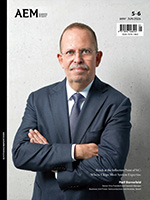
Ralf Bornefeld
Senior Vice President and General Manager
Business Unit Power Semiconductors and Modules, Bosch
SiC is no longer confined to being a semiconductor technology that simply improves electric vehicle efficiency. What Bosch emphasizes as the competitive strength of SiC lies not only in the performance of the chip itself, but also in how it is validated and optimized within the inverter, drivetrain, and overall vehicle platform. With the introduction of its third-generation SiC, Bosch has also proactively disclosed its roadmap up to the fifth generation, signaling a shift from a technology-driven approach to one centered on the market and customer needs. In this interview, Ralf Bornefeld, who leads Bosch’s global SiC business, demonstrates how the company is positioning itself as both an independent semiconductor supplier and an automotive technology partner with deep system-level expertise, even amid increasing price pressure and supply chain uncertainty.
by Sang Min Han _ han@autoelectronics.co.kr
한글로보기
At the same time, it remains a field where expectations, realities, and uncertainties coexist.
From your perspective as the leader of Bosch’s SiC business, what do you see as the biggest opportunity in the market today, and what is the biggest tension that keeps you up at night?
Bornefeld The biggest opportunity is that Silicon Carbide (SiC) is fundamentally redefining what electric vehicles can achieve. It's the key to unlocking longer range, ultra-fast charging, and greater overall efficiency, making e-mobility more practical and desirable for everyone. This technology allows us to move beyond incremental improvements and take a major leap forward in powertrain performance. The tension that occupies my thoughts is related to the slowdown in electric vehicle penetration in all regions beyond China. This results in under-utilized capacity in wafer fabs and in increased competition. The current price level in China is not sustainable in the long run and we are betting on a balance of demand vs. supply coming soon.
From Chip Performance to System-Level Understanding
The introduction of Bosch’s third-generation SiC technology appears to be more than just a generational upgrade.
It feels like a clear statement of intent to take a leading position in the market. Internally, how do you define this moment as a “turning point,” and why was it important to communicate this message to the market now?
Bornefeld Bosch’s SiC Gen3 marks a pivotal moment because it represents a fundamental shift from a technology-driven roadmap to a market-driven one. It was designed from the ground up based on deep system-level feedback from our customers. We didn't just ask what they wanted in a chip, we worked together to understand the challenges they faced in their drivetrains. Therefore, our SiC Gen3 is more than a generational leap in performance. It’s the embodiment of the ideal SiC MOSFET the market has been asking for. It introduces foundational design elements to enhance performance and robustness at the same time. This will be instrumental for all future generations to come. It’s not just a new product but the launchpad for our entire future roadmap, including our evolution to advanced trench concepts in our SiC Gen4 and beyond.
.jpg)
Bosch emphasizes not only the performance of the SiC chip itself, but also how it is validated and optimized within real drivetrain and vehicle systems. How does Bosch define the role of SiC differently from traditional semiconductor companies?
In particular, how do you see power semiconductors contributing not only to efficiency, but also to shaping the driving characteristics and overall “mechanical soul” of an electric vehicle?
Bornefeld For traditional semiconductor companies, the chip is often the final product. For Bosch, it’s the starting point. Our deep alignment with our own internal drivetrain development means we test and validate our SiC devices in real-world systems from day one. This gives us a unique perspective. The system-level understanding allows us to shape more than just efficiency. It directly influences the driving experience, the 'mechanical soul' of the vehicle. By optimizing how the chip performs within the inverter and the wider powertrain, we can fine-tune torque delivery for smoother acceleration, reduce audible noise for a quieter cabin, and enable more compact, lightweight designs for better vehicle dynamics. It’s about translating semiconductor physics into a tangible, superior driving feel.
Bosch has consistently placed the dual-channel vertical trench SiC MOSFET architecture at the center of its roadmap.
Is this primarily a technological choice for performance improvement in the current generation, or a more fundamental strategy to ensure power density, robustness, and reliability through the transition to 200 mm wafers and large-scale industrialization?
Bornefeld It’s fundamentally a strategic choice that delivers superior technology. Our in-house developed dual-channel trench architecture was a deliberate decision from our very first generation because it provides the optimal balance of performance, robustness, and power density. Rather than optimizing for laboratory benchmarks, the focus is on long-term robustness and reliability over the vehicle’s entire service life. This stable and mature process was the critical foundation that enabled our successful transition to 200 mm wafers. By mastering this architecture, we ensure higher uniformity and tighter process control, which directly translates to supply-chain stability and the consistent quality our customers expect as we scale to large-scale industrialization.
.jpg)
Publishing a Roadmap Is a Commitment
Mid- to long-term technology roadmaps are typically shared only selectively.
What motivated Bosch to proactively disclose its roadmap beyond Gen3, extending to Gen5? What kind of confidence do you expect this to give OEMs when choosing Bosch as a long-term partner?
Bornefeld Our motivation is simple: we believe true partnership with customers is built on transparency and trust. Automotive platform development is a long-term commitment, and by sharing our multi-generational roadmap, we provide our partners with the strategic foresight and confidence they need to plan their future vehicle architectures. Our parallel development approach, where multiple generations are engineered simultaneously, ensures an evolutionary, predictable path of innovation. Rather than just highlighting what lies ahead, it enables our customers to clearly anticipate future performance gains and critical technology milestones. When a customer chooses Bosch, they aren’t just selecting a component for today; they are investing in a predictable roadmap of leading-edge technology that guarantees their systems will remain competitive for years to come.
.jpg)
Bosch SiC MOSFET Generation Roadmap: Up to 40% RonA reduction per generation through 2031, alongside the transition to 200 mm wafers
EV platform development is a long-cycle process, and integrating new technologies often comes with unexpected technical challenges. From your perspective, what are the biggest challenges OEMs face when integrating SiC into their platforms, and how does Bosch’s roadmap help simplify and de-risk this process?
Bornefeld The biggest challenge for OEMs is that unlocking the full potential of SiC requires deep system-level optimization. It’s far more than a simple drop-in replacement for silicon. The performance of the chip is ultimately limited by the system around it. This is where Bosch’s core identity as a systems provider becomes a critical advantage for our customers. We don't just sell chips. We de-risk the entire integration process. By using our own SiC devices in our state-of-the-art drivetrain systems, we gain unparalleled insights into how to maximize real-world performance. In combination with our dual-channel trench design, we ensure reliability by design beyond automotive standards. Our roadmap extends far beyond individual products.
It's a comprehensive solution that includes the system-level expertise needed to help our customers navigate the complexities of integration, reduce development time, and avoid unexpected challenges.
The SiC market is evolving rapidly, with increasing price pressure and intensified competition, particularly from Chinese players. In this environment, what do you see as the most fundamental shift in the market? And what would you define as Bosch’s most sustainable competitive advantage in the long term?
Bornefeld The most fundamental shift is that the market is bifurcating. On one hand, you have the commoditization of standard SiC components, which is leading to intense price pressure. On the other hand, you have a growing demand for highly reliable, automotive-grade solutions backed by deep system expertise. Bosch’s most sustainable competitive advantage lies firmly in this second category. Our strength is in innovation, producing a cost-performant chip. We translate the performance gains from each new generation directly into a cost-per-kilowatt advantage for our customers. In the long term, our advantage is the combination of cutting-edge performance, uncompromising automotive reliability, and the system-level understanding that commodity suppliers simply cannot match.
.jpg)
Competitiveness Comes from Reliability,
Not Just Performance
Bosch is making significant investments in expanding its global production footprint, including facilities in Germany and Roseville (U.S.), alongside its transition to 200 mm wafers and multi-sourcing strategies.
Are these efforts primarily about increasing production capacity, or are they aimed at fundamentally addressing OEM concerns around supply chain security in a geopolitically uncertain environment?
Bornefeld They are two sides of the same coin and address the primary concerns of every global OEM today. Expanding capacity is essential to meet exponential growth in demand for EVs. However, capacity without supply resilience is a liability in today’s volatile geopolitical landscape. Our strategy is therefore aimed at building a robust, geographically diversified manufacturing footprint: from our facilities in Germany to our new plant in Roseville, USA. This, combined with our multi-sourcing strategy for substrates, is a direct response to OEM concerns around supply chain security. It’s about providing our customers with the confidence that Bosch can deliver the same product from multiple sites without impacting the customer’s system. It’s about putting our customers' minds at ease.
OEMs are increasingly seeking flexibility and reducing dependence on single suppliers through multi-sourcing strategies. Beyond performance, how does Bosch support customers in achieving greater design flexibility - enabling them to develop their own distinctive inverter architectures and platform strategies?
Bornefeld We recognize that in a competitive market, our customers need to create their own distinctive inverter architectures and platform strategies. Our role is to provide them with a powerful and flexible toolkit, not a rigid, one-size-fits-all component. Our SiC MOSFETs are engineered with a high degree of configurability and optional features like integrated sensors, integrated gate resistors or Al-free power metallization, allowing customers to tune specific parameters to best suit their unique system requirements. This flexibility is built upon a consistent and stable core transistor design. It means OEMs can innovate and differentiate their hardware and driving characteristics on a proven, reliable foundation. Ultimately, we empower our customers to achieve their design goals and create their signature driving experience, while we provide the dependable, high-performance SiC technology that makes it possible.
.jpg)
Bosch SiC MOSFET Design Flexibility: On-Chip Sensing, Copper Metallization, and Bare Die Options for Customization
Flexibility Is Only Possible
on a Foundation of Reliability
Bosch is both a semiconductor company and a leading automotive systems supplier.
Among factors such as chip-level performance, module packaging, system understanding, and supply reliability, what do you believe defines Bosch’s core strength? Ultimately, how would you like customers to perceive Bosch - not just as a component supplier, but as a partner?
Bornefeld Bosch's core strength is not found in any single one of those factors, but in our unique ability to master and integrate all of them. Any company can sell a chip. Very few can match our chip-level performance, integrate it into advanced module packaging, leverage world-class system understanding from our own drivetrain business, and back it all with the supply reliability of a global industrial leader. Our strength is the powerful synergy of these four pillars. Ultimately, we want customers to perceive Bosch as an extension of their own engineering teams. We go beyond the role of a component supplier and act as a strategic partner, offering deep technical transparency and working closely with customers to address their most complex challenges. When a customer chooses Bosch, they aren't just buying a SiC MOSFET. They are gaining a dedicated partner fully invested in their long-term success.
.jpg) Ralf Bornefeld, SVP, during the interview
Ralf Bornefeld, SVP, during the interview
The chip is only the starting point.
Competitiveness is ultimately realized at the system level.
Beyond technological leadership, what role do you envision Bosch playing in shaping the future of this market?
Bornefeld Our ambition is to maintain a leading market position within the top 5 of SiC players. We aim to be the company that defines the future of automotive power electronics. Technology leadership is our foundation, but our ultimate goal is to set the industry standard for what is possible with SiC: from pioneering the next frontier of performance and efficiency to establishing new benchmarks for automotive-grade reliability. By leveraging our unique position as both a device manufacturer and a top-tier automotive systems supplier, we will play a pivotal role in accelerating the adoption of e-mobility globally. Our vision is to make high-performance, ultra-efficient electric drivetrains accessible to everyone, and in doing so, to be a key enabler of a more sustainable and electrified world.
.jpg) Bosch 200 mm SiC Wafer Process - Foundation for Power Semiconductor Industrialization
Bosch 200 mm SiC Wafer Process - Foundation for Power Semiconductor IndustrializationBosch Gen3 SiC: From Technology to Production
Since starting production in 2021, Bosch has supplied more than 60 million SiC chips worldwide and has recently begun sampling its third-generation SiC devices to global OEMs. The Gen3 products deliver approximately 20% higher performance while reducing chip size, improving both power density and cost efficiency.
On the manufacturing side, Bosch continues to invest at scale. At its wafer fab in Reutlingen, Germany, the company is producing SiC chips on 200 mm wafers, supported by around €3 billion in semiconductor investments through the European IPCEI program. Following the acquisition of its Roseville, California facility, Bosch has committed an additional €1.9 billion to expand capacity, establishing a dual-continent production footprint across Germany and the United States.
With 60 million chips delivered, manufacturing bases on two continents, and a roadmap extending through Gen5, Bosch’s SiC strategy is already being executed at scale.
AEM(오토모티브일렉트로닉스매거진)
<저작권자 © AEM. 무단전재 및 재배포 금지>




.jpg)