2026-08-12 / 09월호 지면기사
/ By Sarada Vishnubhatla _ sarada@autoelectronics.co.kr
.jpg)
INTERVIEW
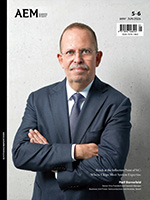
Charles Park
Country Manager
Quest Global Korea
The SDV race doesn't end with developing new technology. The real contest lies in integrating silicon, software, AI and cloud into a single vehicle architecture—then validating it and carrying it into stable mass production. AutoElectronics Magazine sat down with Charles Park, Country Manager of Quest Global Korea, at AID 2026 to discuss how the role of engineering partners is changing, and why Korea may become a critical proving ground for SDV industrialisation.
By Sarada Vishnubhatla _ sarada@autoelectronics.co.kr
한글로보기
"The question today is how efficiently OEMs can maintain and evolve their collaborative relationships with Tier-1 suppliers. The industry's next competitive advantage will come from execution. The real differentiator will be how quickly these technologies can be turned into prototypes and how easily these can be transitioned into stable mass-production systems.”
Charles Park, Country Manager, Quest Global Korea
The automotive industry's transition to Software-Defined Vehicles (SDVs) is reshaping far more than vehicle electronics. It is fundamentally changing how vehicles are designed, engineered, validated and continuously upgraded throughout their lifecycle. As software, artificial intelligence, cloud computing and advanced semiconductors become the foundation of modern mobility, engineering itself has emerged as the industry's new competitive advantage.
Today, the challenge has become significantly more complex. Modern vehicles demand the seamless integration of silicon, embedded software, middleware, cloud platforms, AI algorithms, cybersecurity and systems engineering—while drastically compressing development timelines.
This evolution is also redefining the role of engineering partners. They are no longer expected merely to provide additional development capacity. Instead, they are becoming strategic collaborators, helping OEMs accelerate innovation, validate increasingly complex architectures and industrialise next-generation vehicle technologies.
Quest Global, as a global engineering services provider company, positions itself at the centre of this transformation. Founded in 1997, the company is present in over 20 countries, with more than 23,000 engineers working across 104 delivery centres. Its automotive expertise spans the complete Software-Defined Vehicle stack—from silicon engineering and embedded software to middleware, cloud-connected platforms, validation, AI-driven engineering and systems integration.
At the recently concluded Automotive Innovation Day in Suwon, I spoke with Charles Park, Country Manager, Quest Global Korea, about the changing engineering landscape globally and Quest Global’s role in this context. We also spoke about South Korea's role in the SDV revolution, and why the automotive industry's future will depend as much on engineering collaboration as technological innovation.
Engineering the SDV Era
For Charles Park, the Software-Defined Vehicles represent a shift that extends well beyond software code. Most of the fundamental building blocks required for this are either already available or are evolving rapidly. Though, the real challenge lies in integrating these technologies into production-ready vehicles efficiently.
Rather than being brought in after major architectural decisions are made, engineering partners like Quest Global are being involved during the prototyping phase itself when engineering expertise becomes critical. OEMs are increasingly looking for partners who can accelerate development while reducing engineering risk, rather than simply executing predefined specifications.
"The question today is how efficiently OEMs can maintain and evolve their collaborative relationships with Tier-1 suppliers. The industry's next competitive advantage will come from execution. The real differentiator will be how quickly these technologies can be turned into prototypes and how easily these can be transitioned into stable mass-production systems,” Park says.
Park further explains, "We help rapid implementation and validate solutions. As OEMs and Tier-1 suppliers increasingly become technology integrators, collaboration with engineering partners becomes crucial."
.jpg) South Korea as an SDV Proving Ground
South Korea as an SDV Proving Ground
Equally important is Korea's broader technology ecosystem. Park believes the close collaboration emerging between automotive manufacturers, semiconductor companies, electronics leaders and AI innovators will become one of the country's greatest strengths, enabling faster development and industrialisation of Software-Defined Vehicles.
Unlike companies with relatively limited product portfolios, Korean OEMs face the challenge of implementing Software-Defined Vehicle architectures across an exceptionally broad range of vehicles—from compact passenger cars to premium models, SUVs and commercial fleets.
Park notes, "The way Korean OEMs implement and mass-produce Software-Defined Vehicles across such a diverse vehicle lineup will become an important case study for the rest of the automotive industry."
He believes that this ecosystem, not individual technologies, will become one of Korea's greatest strengths.
From Silicon to Software
Perhaps nowhere is this convergence more visible than in semiconductors today. As software-defined architectures become more sophisticated, compute platforms have emerged as one of the industry's most important competitive differentiators. High-performance computing, AI inference, infotainment, ADAS, autonomous driving and electrification all depend on increasingly capable silicon. These capabilities extend across multiple automotive domains, including ADAS, infotainment, electrification, embedded software, E/E architectures, systems engineering and AI-driven validation, allowing Quest Global to support customers throughout the SDV development lifecycle.
Rather than treating hardware and software as independent disciplines, Quest Global has developed expertise that spans the entire silicon-to-software value chain—from semiconductor design and embedded software to middleware, cloud-connected vehicle platforms, over-the-air update frameworks and connected services that support continuously evolving Software-Defined Vehicles.
"Custom silicon and ASICs are becoming increasingly important for differentiating automotive technologies," Park explains. "We partner with semiconductor companies on silicon design, development and validation, while simultaneously developing the software layers that include SDKs, middleware and applications.”
By co-engineering hardware and software, Quest Global’s goal is to resolve integration complexity early, while accelerating the adoption of new compute platforms by OEMs and Tier-1 suppliers across the entire SDV lifecycle.
AI Beyond the Buzzwords
Artificial Intelligence is often portrayed as the defining technology of the next-generation vehicles but Park emphasizes on its immediate, and practical application.
Inside engineering workflows, AI is already embedded across multiple automotive domains—from perception systems used in autonomous driving and ADAS to battery management, chassis control and validation automation. Its role will continue to expand, both inside the vehicle and throughout the engineering process itself.
At Quest Global, AI is being applied to engineering itself. The company uses AI-driven automation to accelerate software verification and validation, improve infotainment and cluster display testing across multiple configurations, and enhance engineering productivity through faster, more comprehensive test coverage. Rather than replacing engineers, Park sees AI as enabling them to develop and validate increasingly complex SDV platforms more efficiently.
.jpg) Engineering Without Borders
Engineering Without Borders
The nature of Software-Defined Vehicle programmes means engineering can no longer be confined to a single geography. Global OEMs are increasingly finding that building every capability internally is becoming impractical. Quest Global believes this is where its global engineering network delivers tangible value to its customers.
"Korea’s exceptional core engineering abilities sit at the centre of the Software-Defined Vehicle transition," says Park. "Our value comes from combining global scale with local proximity. We give Korean OEMs and Tier-1 suppliers access to specialised engineering capabilities exactly when they need them, and sometimes, even before vehicle specifications have been fully defined.”
Unlike traditional outsourcing models that simply distribute engineering work across geographies, Quest Global allocates responsibilities according to technical expertise. Customer engagement often remains close to the customer, while software engineering, validation, silicon design and AI-enabled testing are distributed across global engineering centres.
"India and other engineering centres follow the same engineering processes, quality standards and review mechanisms, allowing distributed teams to work as one integrated organisation,” shares Park.
This model becomes particularly valuable during early-stage development and later on, for scalability.
“Distributed engineering allows work to continue around the clock across multiple time zones, which helps in accelerating validation cycles and compressing development schedules,” says Park.
India has emerged as a particularly important pillar within this network—not only as a global engineering hub but increasingly as an important automotive market in its own right.
Park believes this collaborative approach enables customers to reduce programme risk while achieving significant cost efficiencies without compromising engineering quality. That systems-level approach has become increasingly important because decisions made in one area often influence every other subsystem across the vehicle.
Solving Industry’s Talent Challenge
While much of the industry's attention remains focused on AI, autonomous driving and advanced semiconductors, Park draws attention to another pertinent challenge that the automotive sector faces today, which is, talent.
He feels, "The skill gap is not only one of the most critical challenges but is also underrated in the automotive industry today."
For many organisations, recruiting talent and expertise is becoming increasingly difficult.
Park argues, "This is not simply a workforce issue. It requires organisational transformation, continuous learning and long-term investment in engineering capability."
Quest Global has responded by investing heavily in employee upskilling and continuous competency development. For Park, the companies that will succeed over the next decade will be those capable of continuously building engineering capabilities needed to adopt those technologies faster than everyone else.
And its only fitting that Quest Global’s aim is to become the most trusted partner for solving the world's hardest engineering problems.
The Software-Defined Vehicle era is often described as a software revolution. But Park believes it is equally an engineering revolution. Success will not be determined simply by who develops the most advanced technologies, but by who can integrate them, validate them and industrialise them the fastest. As automakers increasingly rely on collaborative engineering ecosystems, companies like Quest Global are positioning themselves not merely as engineering service providers, but as strategic partners helping transform innovation into production-ready mobility.
In the years ahead, that ability to connect silicon, software, AI and global engineering talent into one seamless development ecosystem may well become the industry's strongest competitive advantage.
AEM(오토모티브일렉트로닉스매거진)
<저작권자 © AEM. 무단전재 및 재배포 금지>



.jpg)

.jpg)