2026-08-14 / 09월호 지면기사
/ By Sarada Vishnubhatla _ sarada@autoelectronics.co.kr
.jpg)
INTERVIEW
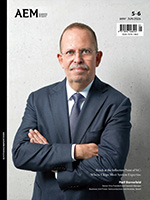
Adar Segal
SVP & Head of Automotive Business, Valens Semiconductor
&
Eric Yoon
General Manager, Valens Semiconductor Korea
MIPI A-PHY is moving beyond specification toward real-world production. Valens Semiconductor is expanding automotive projects in Korea and India, backed by an open ecosystem and reliable long-reach connectivity. Direct integration of A-PHY into sensors can eliminate external bridge ICs and reduce surrounding components, enabling smaller and simpler camera systems for next-generation vehicles.
By Sarada Vishnubhatla _ sarada@autoelectronics.co.kr
한글로보기
Every automotive technology eventually reaches a point where commercial adoption becomes more important than technical specifications. For MIPI A-PHY, that transition now appears to be underway. Production programs are gathering momentum, the ecosystem is expanding, and the technology is moving closer to real-world deployment.
Over the past few years, the demands placed on in-vehicle connectivity have changed significantly. As vehicles adopt higher levels of ADAS, and become increasingly software-driven architectures, enormous volumes of sensor data from cameras, radars and LiDAR systems must travel longer distances without latency, packet loss or signal degradation. At the same time, automakers continue to focus on reducing wiring complexity, vehicle weight and overall system costs.
Among the companies contributing to this evolution is Valens Semiconductor, whose DSP-based physical-layer technology has played a key role in enabling the MIPI A-PHY standard. By using adaptive equalization, real-time noise cancellation and retransmission mechanisms, the technology enables reliable high-speed communication over simpler, lower-cost cabling while addressing the electromagnetic interference challenges of modern vehicles.
With A-PHY moving towards broader industry adoption, Valens has been working with OEMs, Tier-1 suppliers and semiconductor partners to support production deployments. On the sidelines of the 15th Automotive Innovation Day in Suwon, Automotive Electronics spoke with Adar Segal, SVP & Head of Automotive Business, and Eric Yoon, General Manager – Valens Semiconductor, Korea, about the growing momentum behind MIPI A-PHY, the opportunities emerging in Korea and India, and the role of open connectivity in next-generation vehicle architectures.
"Connectivity Will Become One of the Most Critical Safety Layers
in Next-Generation Vehicles"
Adar Segal, SVP - Head of Automotive Business, Valens Semiconductor
What role do you see high-speed connectivity playing in the AI-defined vehicle?
Segal The role of connectivity is no longer just about moving data from one point to another. It is about ensuring safety and enabling the industry to achieve reliable Level 2, Level 2+, Level 3 and eventually Level 4 autonomous driving.
Connectivity has to guarantee that massive amounts of sensor data reach the central processor in real time, without interference or loss. At the same time, OEMs are looking for flexibility. They want to avoid being locked into a single vendor, adopt open standards, encourage competition and secure better pricing. Meeting these technical and commercial expectations is becoming one of the biggest challenges for automotive connectivity.
How does Valens Semiconductor see India in this context?
Segal India is becoming an increasingly important market for us. Beyond the strong relationship between Israel and India, which has encouraged greater collaboration in technology and innovation, we see tremendous momentum in India's automotive sector. Government-led delegations have helped us engage with several high-tech and automotive companies over the past few years, and many of those discussions have evolved into ongoing relationships. We already have employees working in India, while members of our headquarters team regularly visit the country to strengthen customer and partner engagements.
During my meetings in Korea this week, several companies also identified India as one of the next major growth markets for the automotive industry. We see the same trend. As Indian OEMs accelerate investments in software-defined vehicles and higher levels of ADAS, the demand for high-speed, resilient in-vehicle connectivity is expected to grow significantly.
We are already engaging with leading Indian OEMs and Tier-1 suppliers to introduce MIPI A-PHY and Valens' VA7000 chipset family. As vehicles become more sensor-intensive and centralized in architecture, OEMs need connectivity that can deliver high-bandwidth data with exceptional reliability throughout the vehicle's lifetime. We believe our technology is well positioned to support that transition.
Moving to Korea, you have described it as another promising market. What makes it strategically important for Valens?
Segal We have built a strong local team in Korea because we believe the country has one of the world's most innovative automotive ecosystems. There are numerous companies here developing advanced technologies for future vehicles.
To work successfully with Korean OEMs and suppliers, building local partnerships and long-term collaborations is essential. That is our focus as we continue expanding our presence in the market.
What has changed the most in OEM requirements for high-speed automotive connectivity over the past few years?
Segal One of the biggest shifts is the move toward open standards rather than proprietary technologies. OEMs increasingly want greater control over their supply chains instead of depending on a single vendor. At the same time, evolving safety regulations are raising the bar for connectivity solutions. OEMs now expect technologies that deliver higher reliability and functional safety while also helping reduce overall system costs.
Many companies focus on AI computing performance. From your perspective, where is the real bottleneck today—is it computing, or getting sensor data to the processor reliably and with low latency?
Segal The architecture of modern vehicles is changing rapidly. Processing is increasingly being consolidated into centralized computing architectures, while zonal controllers aggregate data and functions at the vehicle’s edge. That means cameras, radars and other sensors must transmit enormous amounts of unprocessed data over longer distances to a central computer, and they must do so in real time without errors or delays.
As vehicles become larger and sensor counts continue to increase, bandwidth requirements also grow significantly. In our view, reliable high-speed connectivity is becoming one of the industry's biggest challenges, and that is precisely where our technology is designed to deliver value.
.jpg) Everyone supports open standards in principle. But in real production programs, where do interoperability challenges still remain?
Everyone supports open standards in principle. But in real production programs, where do interoperability challenges still remain?
Segal Not every technology described as a standard is truly open. Designing an open standard requires a genuine commitment to allowing multiple companies to participate and compete.
At Valens, our objective has always been to grow the entire A-PHY ecosystem by encouraging OEMs, Tier-1 and Tier-2 suppliers, and semiconductor companies to adopt the standard. Building such an ecosystem takes time. A-PHY itself does not prevent new participants from entering the market, but some competing technologies remain more proprietary in nature. The industry is still evolving.
Do you see optical connectivity as a long-term competitor to copper-based A-PHY? What problems will optical networking solve that copper cannot?
Segal We continue to discuss this with OEMs, but today the complexity of deploying optical networking inside vehicles remains a significant challenge. A vehicle experiences constant vibration, movement and harsh operating conditions over many years. Many OEMs are not yet convinced that current optical solutions can deliver the long-term durability, reliability and cost-effectiveness required for automotive production.
Meanwhile, copper continues to evolve. Modern coaxial and copper cables offer excellent performance at increasingly competitive costs.
Our view is that the cable itself is not the bottleneck. If the physical-layer technology is robust enough, it can transmit very high data rates over simple, low-cost copper cables. That is exactly the problem we are solving—delivering reliable, high-speed communication over affordable automotive wiring.
Eric Yoon
GM, Valens Semiconductor Korea
While Adar Segal discusses the global evolution of MIPI A-PHY, Eric Yoon highlights how Valens is approaching adoption in Korea, including industrial applications, automotive PoCs and the development of a local ecosystem.
Valens has been actively expanding its presence in Korea. What is your strategy for driving MIPI A-PHY adoption in the market?
Yoon Valens Korea is pursuing opportunities across both the industrial and automotive sectors. We initially focused on industrial applications, where development cycles are shorter, and our solutions have already been integrated into medical and robotics applications that are approaching mass production.
Automotive programs naturally require longer qualification cycles, but we are actively working with Korean OEMs, Tier-1 suppliers and technology partners to validate MIPI A-PHY for future vehicle programs. We are also working with local ecosystem partners on future sensor integration.
Our goal is to help build a strong MIPI A-PHY ecosystem in Korea by working closely with local partners and supporting the industry's transition to open, standardized connectivity.
Which A-PHY applications are expected to enter production first in Korea?
Yoon Surround View Monitoring (SVM) systems for overseas OEMs are expected to be the first A-PHY applications to enter mass production. Multi-camera systems (8+ channels) for commercial and specialized vehicles are also expected to reach commercialization for export markets between 2027 and 2028.
What commercial vehicle use cases require transmission distances of more than 40 metres?
Yoon Key use cases include surround-view and camera monitoring systems, or electronic side mirrors, for articulated buses, large tractor-trailers, specialised heavy-duty trucks and construction equipment.
Take a tractor-trailer, for example. The signal has to travel from the tractor to the rear of the trailer, but the cable does not run in a straight line. It has to follow a complex route around various structures, so the actual cable length can easily exceed 30 or even 40 metres.
The same applies to large logistics trucks and construction equipment. To eliminate blind spots, these vehicles may use multiple high-resolution cameras around the front, rear, sides and even underneath the vehicle. In some cases, they may also incorporate sensors such as 3D LiDAR. If you want to transmit all that data reliably to a central ECU without relying on compression, signal quality must be maintained over very long distances. This is where the advantages of ultra-long-reach A-PHY become particularly clear.
At what stage are the automotive PoCs currently under way in Korea?
Yoon We have now reached the system validation stage. Working with major Korean camera-module suppliers and Tier 1 partners, we have completed schematic reviews for boards incorporating A-PHY transceiver chipsets, and the boards themselves have also been built.
We have gone beyond laboratory testing. The systems were installed in actual OEM test vehicles and tested against competing technologies. The results confirmed that A-PHY is highly competitive in terms of both performance and stability. The next important step is to turn these technical validation results into actual vehicle programmes and production projects.
.jpg) What components can be eliminated by embedding A-PHY directly into a sensor?
What components can be eliminated by embedding A-PHY directly into a sensor?
Yoon The first component that can be eliminated is the standalone SerDes transmitter, or bridge IC. Today, data generated by a sensor is typically sent through an external SerDes transmitter. If A-PHY IP is integrated directly into the sensor SoC, that external transmitter is no longer required.
This also allows us to reduce the number of surrounding components, including external crystals or oscillators, certain power-management components and passive components such as decoupling capacitors. As a result, we can reduce both PCB space and the bill of materials, while making the camera module itself more compact.
Reducing the component count also brings thermal and manufacturing benefits. Thermal-management design becomes simpler, there may be opportunities to reduce the number of PCB layers, and assembly and manufacturing costs can also be lowered. So, integrating A-PHY is not simply about changing the communications interface. It can simplify the overall design of the sensor module.
What changes are required for MIPI A-PHY to establish itself as a mainstream automotive connectivity standard in Korea?
Yoon The most important requirement is the ecosystem. The Korean automotive market has relied on proprietary SerDes technologies such as GMSL for many years, so the market will not change simply because a new chipset becomes available. For A-PHY to become mainstream, we need to build a local ecosystem around the global MIPI standard in which multiple companies can participate.
Korean Tier 1s and component suppliers will need to move together. A new value chain must be created around the standard, covering not only A-PHY chipsets but also sensor-integrated ICs, cables and connectors. When multiple suppliers can compete on the same standard, OEMs gain more supply-chain options and the commercial advantages of an open standard become tangible.
We also need to create new use cases in which A-PHY’s particular strengths are clearly visible. These might include large commercial or specialised vehicles requiring cables longer than 15 metres, or next-generation SDV architectures that must transmit data reliably in very challenging EMI environments. If A-PHY first demonstrates its value in applications that are difficult or expensive to address with existing technologies, wider market adoption could accelerate.
Ultimately, perceptions among OEMs and Tier 1s also need to change. A-PHY should not be viewed simply as another product that can replace an existing SerDes solution. It should be understood as a new connectivity architecture that can expand the supply chain and simplify system design through an open global standard. Once that understanding takes hold, MIPI A-PHY can become one of the standard design options considered from the beginning of new vehicle programmes.
AEM(오토모티브일렉트로닉스매거진)
<저작권자 © AEM. 무단전재 및 재배포 금지>



.jpg)

.jpg)